


“When you enter a house, first say, ‘Peace to this house.”
Luke 10:5
Home. It’s only one word, yet it holds so much. It’s like a guarantee, something to return to after a long day. For our neighbors experiencing homelessness, it’s an accomplishment. But the road is not always easy. Finding housing comes with barriers beyond their control—ones we would never consider.
KARM recently began a new program model and has seen record-breaking guest involvement in classes and job training programs, including seeking guidance from case managers. Our guests are taking steps towards restoration!
With this new program model in place, KARM has increased its housing efforts and Aftercare initiatives to help people become homeless no more. Let’s dive into the causes and barriers surrounding homelessness, and how rewarding it is when our guests turn the keys to their new life.


What Causes Homelessness
Before we understand housing, we have to understand homelessness. We can’t approach housing as a two-dimensional problem and expect anything to change: we have to meet guests where they are.
So, how does someone become homeless? Here are some of the complex reasons guests enter our doors:
- Lack of Affordable Housing
- House Fire
- Job Loss
- Financial Instability
- Family Conflict
- Loss of Loved Ones
- Foster Kid Turning 18
- Divorce
- Addiction
- Mental Illness/Health Issues
- Disability
- Trauma
Most, if not all, struggle with multiple items on this list. That’s not to mention the stress our guests suffer from experiencing homelessness.
KARM steps into the gap of homelessness and a restored life by offering care and resources for guests to receive lessons on life skills and job training on top of emergency services. This helps guests take the next step towards housing! But that can come with its own set of struggles.
Barriers to Housing
Being ready for housing and acquiring housing are two different things. Securing housing involves having the proper documents, a stable income through work or benefits, and an apartment available to rent.
Checking every box on the list does not come easy. I sat down with Amos, the Housing Coordinator, and Susan, the Health Services Manager, to talk about these barriers and what they mean for our guests.
The Homelessness Barrier
Patterns are not easily broken. We have to understand that for most of our guests, they have been homeless for years. Transitioning from a lifetime of chronic homelessness to being housed is not an easy feat, especially for those who struggle with mental health or disabilities.
And for someone hoping to exit homelessness, finding housing can prove to be a challenge. Amos shared how, “In order to be eligible to be placed on a wait list for permanent supportive housing, you have to be chronic status, which means you’ve had a full year of homelessness that you can prove.”
Many people don’t have a paper trail confirming their homelessness because they spent their years living on the streets, in their car, or hopping around on friends’ couches. For others, their homelessness is recent because they lost their spouse that they depended on or aged out of foster care.
Susan described how some foster parents, who foster out of greed, send kids away the moment they turn 18. “They’re lost…they’re kids,” Susan expressed. When they arrive at KARM, they come from “stable” housing, so on paper they seem well adjusted. In reality, that couldn’t be further from the truth.
It’s hard enough to experience homelessness; it’s another thing entirely to have to prove it. Thankfully, our team works to help find alternative opportunities that best support our guests’ needs.
The Housing Market Barrier
Rent should be no more than 30% of your income, yet in the Knox area, the average prices for apartments are up to $1,300 – $1,700. For our guests, that’s nearly impossible to achieve. (learn more here)
Low-income housing helps this issue, but there is high demand, and it often leads to waitlists. It is also significantly easier for someone in their 60s to have more options for housing than those who are younger. This is because they may receive benefits from Social Security, disability, or veteran aid. Those who are in the age range of 20-50 years old aren’t eligible for certain aid or resources. Amos explained:
“If rent prices were what they were before COVID, I think it would be a totally different landscape. But the way the market is today, it’s easier for someone who’s disabled or over 62 to find housing. For those who are younger, they could be making minimum wage or just barely above. They could be trying hard but just not making enough to afford anything. That is the most at-risk group in my opinion.”

The Health Barrier
For some, living alone is not an option. Mental health and physical ailments can be real barriers for people hoping to secure housing. “Permanent supportive housing has tons of support set up, but you have to be independent. You have to be able to do for yourself.” Amos explained.
People can fall in between supportive housing and assisted living/nursing homes. Susan explained that, “there’s a certain level of need that you have to have to qualify for nursing homes.” Susan went on to share a story about a gentleman who no longer qualified for a certain assisted living facility because he was adamant about using his walker instead of a wheelchair.
This creates a gap for guests who are unable to fit into one box or the other. “So what do you do with them?” Susan asks, “There is no in-between, so it’s either a nursing home or assisted living or independent living. Independent living is completely out for some of our guests.”
Through these barriers, our staff never gives up and continues to hold on to hope because our guests are worth it.
The Housing Reward
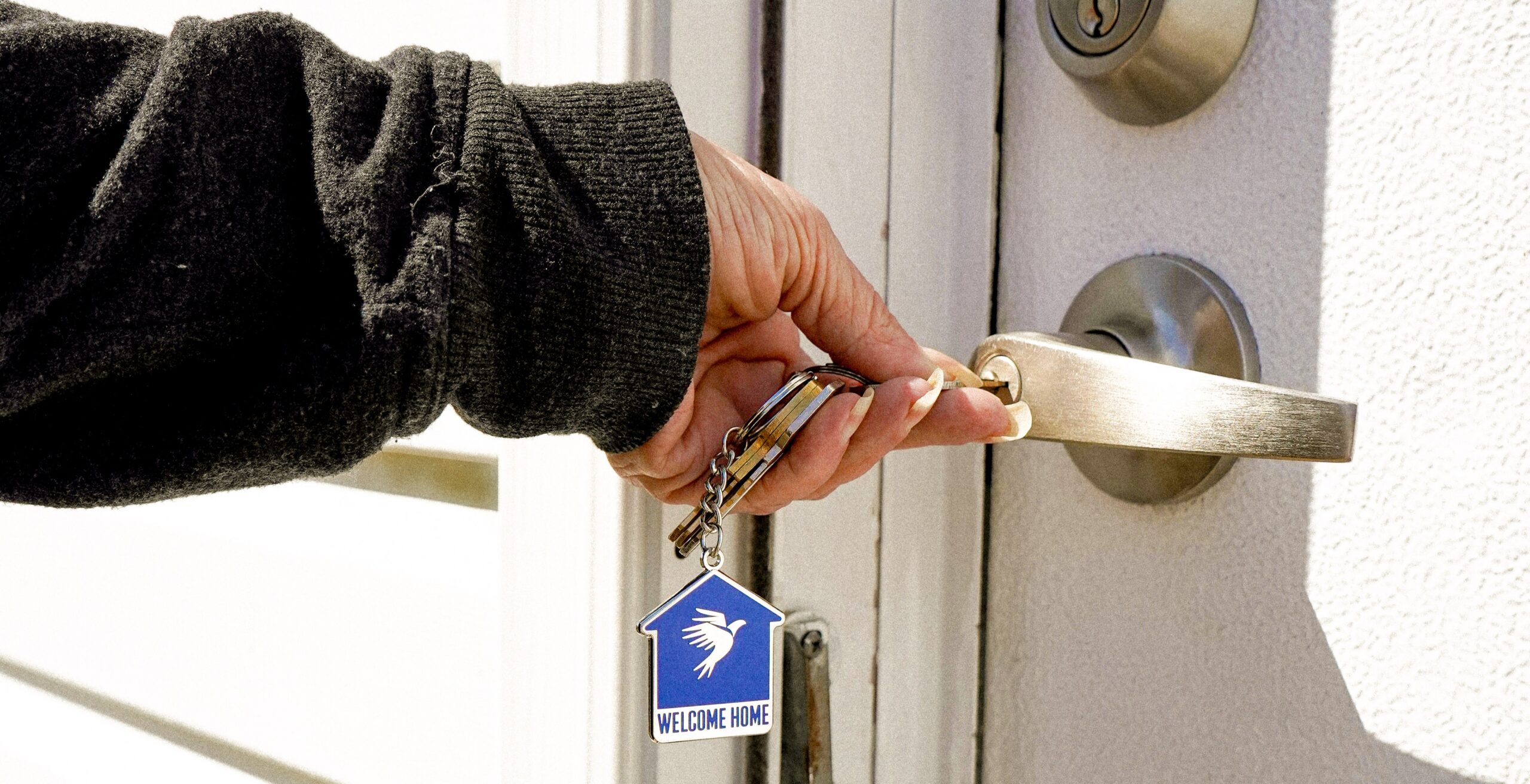
Trials, rejections, and setbacks are nothing compared to the joy of a guest receiving the keys to their new home. In that moment, it’s as if God’s faithfulness to restore and rebuild is on display. Don’t just take my word for it; here are some stories and quotes from our staff and guests!
Guests:
“KARM has given me hope so that I can move into an apartment and be safe in my future instead of continuously homeless.” -Ana, KARM Guest
“Home means that place where you get to just relax, be yourself.” -Shane, KARM guest
Staff
“A guest said, ‘Well, the first day I just stood there with my key in the lock, turning back and forth. It just didn’t seem real.’ This guest is in his 50s, and this is the first time he’s had his name on a lease.” – Judge, Guest Transformation Coordinator.
“A guest, after picking out items for her apartment at a KARM store, became overwhelmed. ‘She was crying and said, ‘I’m so sorry. I’m so sorry. I’ve just never done anything like this in my life,’ and I’m sitting there going, she’s never in her life been able to go buy her own furniture, and all these things fill up an apartment. Just the weight of that. “ – Judge, Guest Transformation Coordinator.
“When I was moving another guest, someone came up to me and asked, ‘Have you seen my apartment?’ When I went in, I didn’t see a single new thing in his apartment besides what we moved two weeks before, but he was so proud of his apartment.” – Judge, Guest Transformation Coordinator.
“I remember the first person I helped move out. He was nervous and a little excited. I asked how he was doing, and he let me know he was going through something difficult. The move-in went okay, and I kept in contact with him. We’d meet for lunch. At the place he stays, one of the best things is that they have a church that will come where they are at and set up shop with snacks to hang out. I got to oversee for about a year this guest getting connected to this church and volunteering. Then I got to see him get baptized on a Sunday morning at that church.” -Drew, Aftercare Coordinator.
Praise God for how he’s worked these guests’ lives! Housing is complex, yet God is faithful. I want to leave us on a quote Susan said,
“There’s just a great need, and everybody plays a part of it. Nobody has a bigger part than someone else, and it’s going to take us all to do it.”
For more information on what comes next after housing, look at our First Look into Aftercare (coming soon!).
Highlights
1. A highlight I wanted to show was Amos’ heart for our guests. A lot of it stems from his own background. He said he was in a heavy addiction for 25 years and did time in prison, but he worked his way up, received his associate’s degree, and now works at KARM helping people who were just like him. He has been at KARM for around three years now, and though he’s had different titles, helping guests receive housing is where he feels he belongs. He said, “In everything that I’ve done here at KARM, it’s kind of like you never get to see the fruits of your labor. With housing, we talk about helping people get housed all the time, but actually getting to tell somebody, “Hey, you’re approved. We’re going to sign your lease, and watch them get their keys. That’s what did it for me. I love it.”
God uses what the enemy meant for evil, and he turns it for good. Just like he did for Amos, just like he does for our guests, and just like he does for you!
“As for you, you meant evil against me, but God meant it for good…” Genesis 50:20
Did You Know
187 people were housed in 2025! The goal is to have 200 housed by December this year!
You can be a part of helping our guests move into their new homes and be a friend as they continue their journey of exiting homelessness!
Aftercare has three volunteer opportunities:
- Movers- Helping guests move their items into their new apartment
- Companions- Walk alongside participants by keeping in contact and spending time with them.
- Community Groups- Participate in leading a lesson or activity at a variety of housing environments
To volunteer, you can go here, or you can email Mark Roberts, mroberts@karm.org, for a tour to learn more.

By: Laura Lee Cochran; Marketing and Copy Coordinator
This post is a part of our First Look article series. Its goal is to give you a first look experience into volunteering at KARM while highlighting our many programs.